
Painting Through It: Dr. Nicole Anderson-Cobb Finds Joy, Grief, and Advocacy in Watercolor
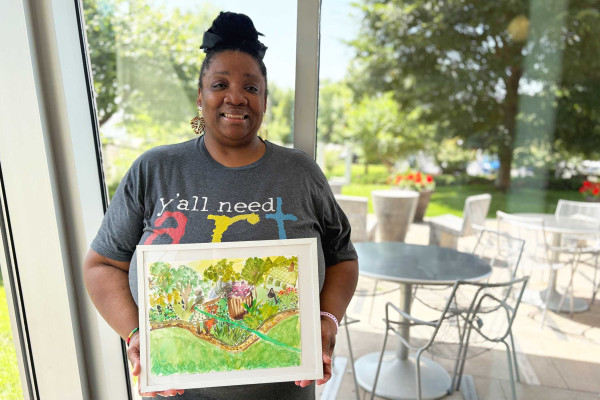
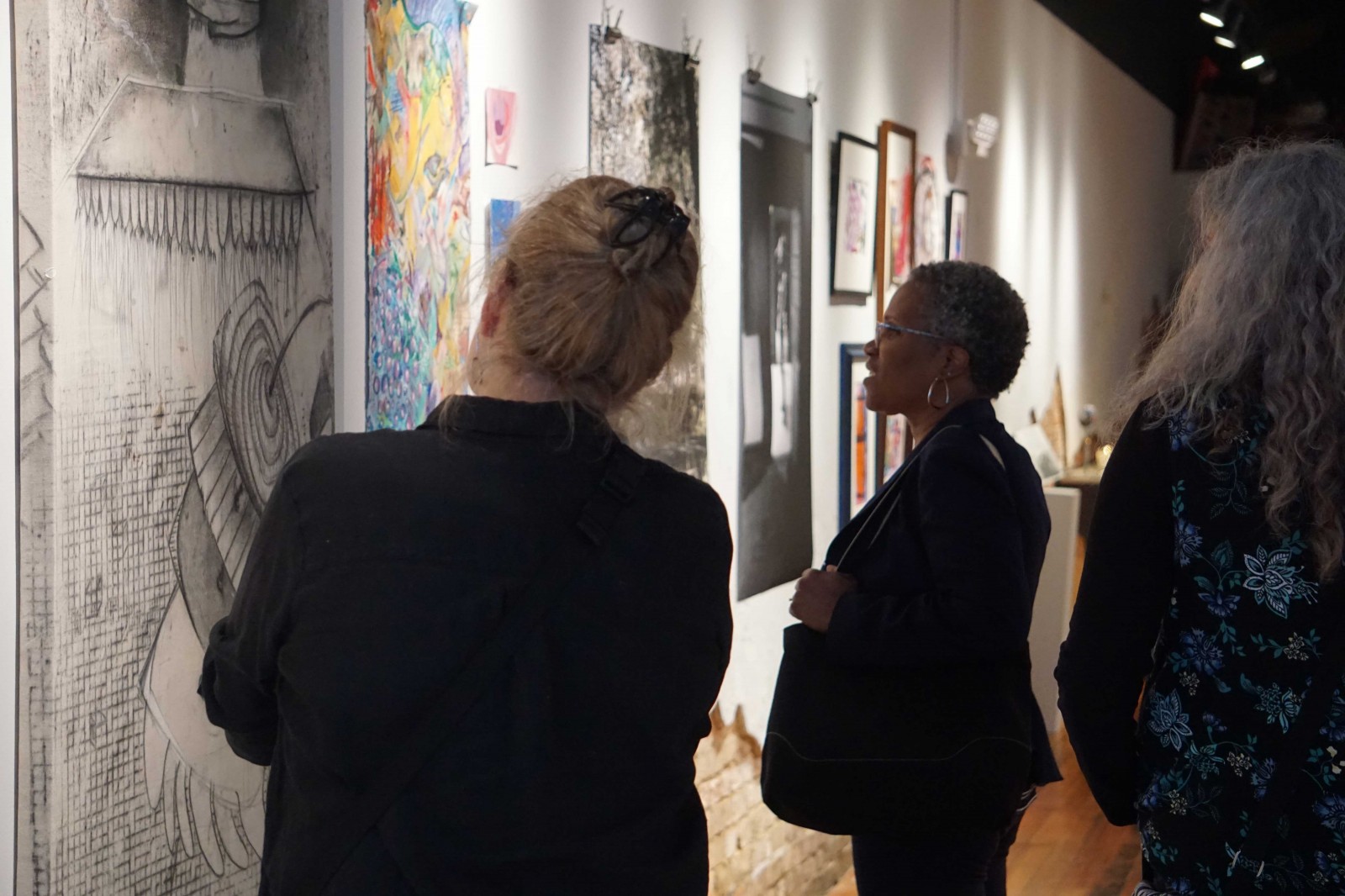
Dr. Nicole Anderson-Cobb didn't set out to become a painter. A historian by training and a longtime advocate by upbringing, she picked up watercolors almost on a whim a few years ago and hasn't put them down since. Today, her work hangs in Springer Cultural Center in downtown Champaign as part of the What We Carry Forward exhibition, running through August 1. Anderson-Cobb’s body of paintings are born out of community, grief, and an insistence on documenting Black joy in outdoor places.
An Unlikely Beginning
Dr. Anderson-Cobb's entry into painting came through a friend and mentor, Dr. Rae Ferguson, who did a postdoctoral fellowship at the University of Illinois while Anderson-Cobb was deep in her graduate studies—work that would eventually earn her a master's degree in African history in 1999, and, in 2007, a PhD in African history, making her the first Black woman to achieve that distinction at the university. Anderson-Cobb also earned a second master's degree in journalism from the University of Illinois in 2017. For years, Dr. Ferguson gently pushed her to join her weekly watercolor sessions. Anderson-Cobb resisted at first; she didn't know what she wanted to paint. Eventually, she picked up some supplies to see what would happen.
Something clicked. She and Ferguson kept meeting every couple of weeks, trading photos of their progress, and what started as landscapes and flowers grew into something much bigger.
 Dr. Anderson-Cobb’s growth as a painter accelerated under pressure. Her mother was living with dementia, and Anderson-Cobb became her caregiver, spending as much as twenty hours a day at her side. She painted in the gaps while her mother rested. It was a way to step outside the weight of caregiving, however brief. (Her mother-in-law has called the practice her therapy.) Then the outbreak of the Israel-Hamas war compounded her grief. Painting became a way to move through it, season by season.
The Parks That Hold a Community Together
Much of Dr. Anderson-Cobb's recent work returns again and again to a single subject: local parks. It traces back to the isolation of the COVID-19 pandemic, when she and a friend began taking their daughters to Mattis Park every Friday (they called it "Fun Fridays") to give their kids a break before Zoom school but also stay virus-free. From there, her attention widened to the labyrinth at Carle, the hopscotch at Colbert Park, and the many other green spaces around Champaign-Urbana.
Although she grew up on the South Side of Chicago with a park within reach of her childhood home, Anderson-Cobb has been struck by how many exist in C-U—and by what they’ve come to mean for families navigating the pandemic. It carries a historical weight, too. Her parents were part of the generation that left the Jim Crow South, and she describes her family's relationship to public space as never fully free of caution. Her brother-in-law once served as a police chief, which she says makes her family "Black-and-blue,” and therefore attuned to both sides of the relationship between Black communities and law enforcement. In Anderson-Cobb’s paintings, parks become sites of hard-won ease.
 For example, Field Day revisits an annual event at Canaan Academy — a school her daughter once attended, now closed — where Black families gathered for a day of unguarded play. Cobb painted roughly a dozen versions of the scene, drawn to what she describes as the interconnection of nature, innocence, and freedom. Another painting, Babygirl at Prayer for Rain, West Side Park, Champaign, grew out of her curiosity about the central statue in West Side Park; she researched its origins and the artist behind it, and eventually collaborated with her daughter on a short film about what the statue represents to the community, past and present.
Painting as Tribute
The What We Carry Forward exhibition doubles as a memorial. Dr. Anderson-Cobb's close friend, fellow artist and advocate Latrelle Bright, passed away in September 2025, within two weeks of her own mother. She and Bright had shared artist residencies together at Allerton Park. Last spring, working back through notes from that time, she began painting Bright without knowing she would fall ill so suddenly afterward. The result was a series of paintings depicting Bright in a white dress, walking the Allerton grounds. Anderson-Cobb sees the exhibition as a way of honoring their friendship.
The exhibition itself was originally conceived under the title Black Outside before evolving, as a group show with two other artists, into a name that could hold all three artists' work. Its throughline is her abiding interest in painting Black families outdoors: joyful, unguarded, and free.
 When the Work Bears Witness
Dr. Anderson-Cobb describes her practice as moving back and forth between observational and political art. One recent series, Civic Violence: Black Women in Freefall, grew from a deeply personal place. A Washington Post story about the gap between Black women's credentials and job opportunities hit close to home through sorority sisters, family members, and women in her own community navigating that same reality. She painted panels of Black women depicted upside down, giving quiet and powerful form to that precarity. An arts collective's open call for women's art picked up the series and amplified its message.
A second series, The Backpacks of Minab, responded to news of a school bombing that killed 168 children. Unable to fully articulate her grief, she repurposed old paintings, cutting them into backpack shapes and assembling an artwork built around the haunting image of a pile left behind. The work was later featured in a lament service at First Mennonite Church. She went on to sell postcard prints at the Boneyard Arts Festival, directing a portion of the proceeds to World Central Kitchen — which sent her a letter detailing exactly how many people the donation had helped feed. That kind of tangible connection between art and impact, she says, is part of what keeps her making work.
Craft, Mentorship, and What Comes Next
Dr. Anderson-Cobb continues to study the medium, most recently taking an online class with Mario Robinson, a nationally recognized African American watercolorist whose Smithsonian-exhibited work focuses on Black subjects — a rarity she finds significant. For one assignment, students spent five weeks on a single portrait of a bald African American woman, an exercise in rendering the range of Black skin tones that she found affirming. She was thrilled when Robinson asked to follow her on Instagram after learning about her upcoming exhibition; the two are now connected on Facebook as well. Robinson, based on the East Coast, has also expressed interest in the University of Illinois arts community, where he has mutual connections with local Black faculty artists Patrick Earl Hammie and Stacey Robinson.
Watercolor remains Anderson-Cobb’s medium of choice for its immediacy and economy. She says she needs surprisingly little paint (aside from a constant shortage of green) to produce something she's proud of, and tries to paint something every day, even if only for a few minutes.
 Dr. Anderson-Cobb attributes much of her worldview to her upbringing: her mother was an educator, her father a social worker, and advocacy was simply part of the household atmosphere growing up. She holds four degrees; her husband works in university administration. She describes her family’s position as one of privilege that carries an obligation — to speak on behalf of people whose circumstances don't allow them the same freedom. Her mother had her at age sixteen and placed her for adoption; her husband was raised by a single mother of five. Their shared understanding of what education can do for a family, she says, is part of what drew them together.
Her husband's family has deep local roots as well, with four generations tied to the University of Illinois — from relatives who cooked and worked in fraternity houses to uncles who became electricians and carpenters, and others who attended the university as students.
Looking ahead, Dr. Anderson-Cobb plans to keep working across the same lanes that have shaped her career so far: education, art, political engagement, and faith. For now, her focus is on getting people into the current exhibition before it closes August 1 — to see the work, talk about it, and spend time in a space built, much like her paintings, around the idea of shared, unguarded community.
Featured artworks:
Babygirl at Prayer for Rain, West Side Park, Champaign
Civic Violence #1: Black Women in Freefall
Babygirl in Grandma Dee's Backyard
Thank you to Dr. Nicole Anderson-Cobb, her daughter Tyler, and Experience Champaign-Urbana intern Cadence Wright for their participation, time, and insight.